
The 2026 agent leap in market analysis
The era of simple prompts is over. We are witnessing a shift where artificial intelligence orchestrates complex, end-to-end workflows semi-autonomously. This transition marks the move from passive data retrieval to active operational execution, allowing systems to plan, optimize, and act within real market environments.
In 2026, understanding how these agents function is no longer optional for strategic decision-making. The global AI agents market, valued at USD 7.92 billion in 2025, is projected to reach USD 11.55 billion this year, expanding at a CAGR of 43.57% through 2035. This growth reflects a fundamental change in how market intelligence is gathered and applied.
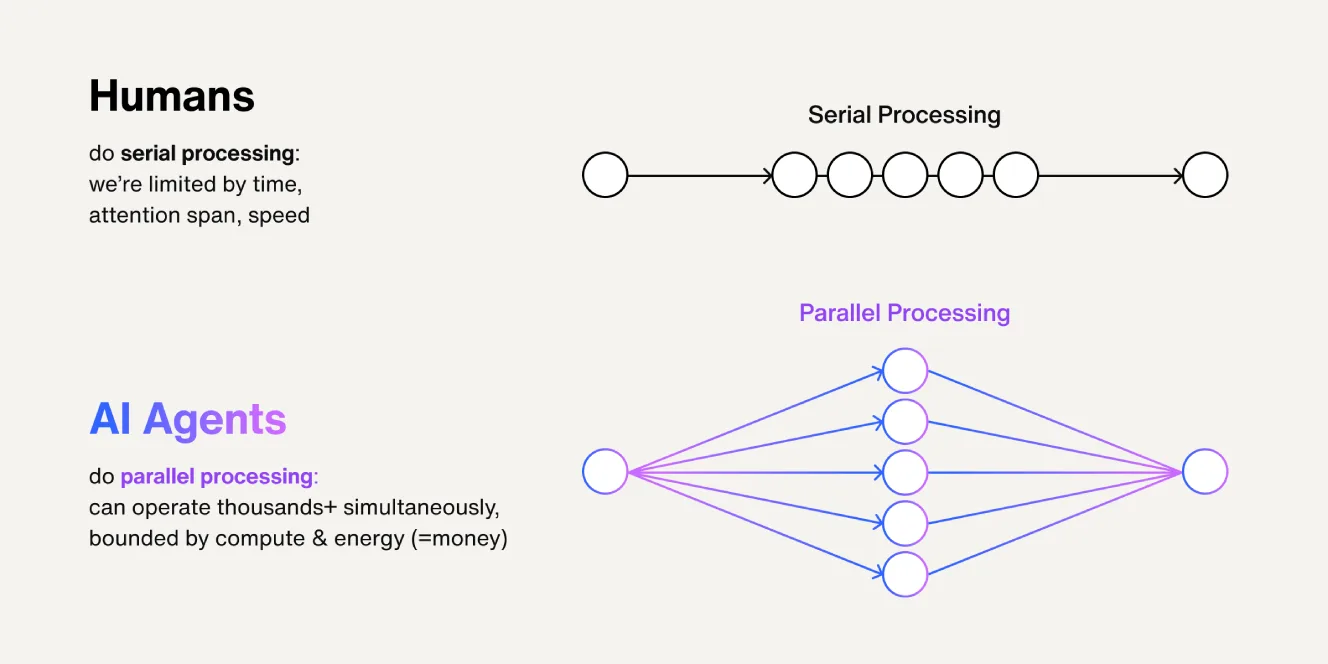
These autonomous systems combine advanced intelligence with the ability to use tools and take actions on your behalf. Rather than waiting for a human to query data, AI agents now monitor market signals, execute research workflows, and deliver synthesized insights. This operational capability transforms market analysis from a reactive task into a proactive strategic asset.
Autonomous agents for predictive analytics
Predictive analytics has shifted from static reporting to continuous adaptation. In 2026, autonomous agents handle this shift by treating market data as a live stream rather than a periodic snapshot. These systems gather, clean, and analyze information in real time, allowing strategies to adjust before human analysts even notice a trend change.
The core value lies in the feedback loop. An agent monitors specific market signals—such as volatility spikes or sentiment shifts—and immediately recalibrates predictive models. This removes the lag between data collection and strategic action. As noted in industry analyses, we are moving past simple prompts toward systems that orchestrate complex, end-to-end workflows semi-autonomously.
This operational shift is why the market is expanding rapidly. The market is projected to grow from $11.55 billion in 2026 to nearly $295 billion by 2035. This growth reflects a broader realization: once AI systems begin acting inside real workflows, understanding how they plan and execute is no longer optional for competitive finance teams.
Compare top AI agent platforms for 2026
The enterprise AI agent market is projected to grow from $11.55 billion in 2026 to nearly $295 billion by 2035, driven by operational autonomy rather than simple chat interfaces. For market strategy teams, the choice of platform hinges on integration depth, autonomy level, and total cost of ownership. The following comparison highlights four leading frameworks and platforms currently shaping enterprise workflows.
| Platform | Autonomy Level | Integration Ease | Cost Structure |
|---|---|---|---|
| LangGraph | High (Multi-agent orchestration) | Medium (Code-first) | Open source (Cloud hosting fees) |
| AutoGPT Enterprise | High (Self-directed planning) | Low (Standalone agent) | Subscription + API usage |
| Microsoft Copilot Studio | Medium (Human-in-the-loop) | High (Microsoft 365 native) | Per-user license |
| CrewAI | Medium (Role-based collaboration) | Medium (Python SDK) | Open source (Cloud hosting fees) |
LangGraph and CrewAI offer flexible, code-first environments ideal for engineering-led teams building custom market research agents. LangGraph excels in complex, multi-agent orchestration where state management is critical. CrewAI simplifies role-based collaboration, allowing distinct agents to handle segmentation, content generation, and distribution simultaneously. Both rely on open-source cores, shifting costs to cloud infrastructure and developer time.
For organizations already embedded in the Microsoft ecosystem, Copilot Studio provides the lowest friction for deployment. Its native integration with Dynamics 365 and Power BI allows market strategists to trigger agent workflows directly from existing dashboards. However, its autonomy is more constrained, requiring human approval for significant actions. AutoGPT Enterprise offers high-level self-direction but often demands more manual oversight and API budgeting, making it suitable for specific, high-volume automation tasks rather than broad strategic planning.
Integrating onchain payments with agent workflows
Autonomous agents are moving beyond simple data retrieval to executing financial transactions directly on the blockchain. This integration allows market strategies to settle in real-time, removing the latency between decision-making and execution. When an agent identifies a profitable arbitrage opportunity or rebalances a portfolio, it can trigger a smart contract transaction without human intervention.
This capability transforms the agent from an advisory tool into an operational worker. By embedding payment rails directly into the workflow, businesses can automate complex, multi-step financial processes. For instance, an agent can monitor supply chain data, verify delivery via oracle, and release escrowed funds to suppliers instantly. This reduces administrative overhead and minimizes the risk of human error in high-volume transactions.
However, automating financial settlements introduces significant security considerations. Agents must be rigorously tested to prevent exploits, as a flawed logic loop could drain funds faster than a human could react. Implementing multi-signature wallets and strict permission boundaries is essential to contain potential losses. The goal is to create a system where automation handles routine settlements while maintaining human oversight for critical thresholds.
The convergence of AI planning and blockchain settlement is reshaping how market strategies are implemented. As the market expands, the ability to execute onchain payments seamlessly will become a standard requirement for competitive financial workflows. This shift enables a new class of applications that operate with speed and precision previously unattainable in traditional finance.
Implementing AI Business Automation Safely
Deploying AI agents in high-stakes market environments requires a shift from experimental coding to rigorous operational discipline. As the market expands, the cost of failure rises. A single uncontrolled loop can trigger flash crashes or compliance breaches before human oversight intervenes.
Follow this checklist to ensure your deployment maintains integrity, compliance, and risk management.
Before deployment, map every data source feeding your agents. Verify that training data is clean, unbiased, and legally compliant. In financial markets, stale or poisoned data leads to catastrophic mispricing. Document the provenance of each input to satisfy regulatory audits.

Configure hard constraints on agent actions. Set maximum trade sizes, stop-loss thresholds, and API rate limits that the agent cannot override. These guardrails act as circuit breakers, preventing the agent from executing unauthorized or excessive transactions during market volatility.
Run your agents in a simulated environment that mirrors live market conditions but uses historical or paper-trading data. Monitor for edge cases, latency issues, and unexpected behaviors. This phase is critical for validating that the agent’s decision-making logic aligns with your risk tolerance.
Once live, maintain continuous human oversight. Implement real-time dashboards to track agent performance, decision logs, and system health. Establish clear protocols for manual intervention if the agent deviates from expected parameters. Regular reviews ensure the system adapts to changing market dynamics.
Safe automation is not about removing humans; it is about augmenting them with reliable, bounded tools. By following these steps, you can leverage AI agents to enhance market strategy while maintaining the safety required for high-stakes operations.
Market Size and Growth Forecasts for 2026
The global AI agents market is accelerating from $7.92 billion in 2025 to an estimated $11.55 billion in 2026, according to Precedence Research. This 46% year-over-year jump signals a shift from experimental pilots to operational deployment. As Google Cloud notes, we are witnessing an "agent leap" where AI orchestrates complex, end-to-end workflows semi-autonomously.
This growth is driven by the need for autonomous market research. Once AI systems begin acting inside real workflows, understanding how they plan and execute becomes mandatory for competitive strategy. The market is predicted to expand at a CAGR of 43.57% through 2035, reaching approximately $294.66 billion.
Investing in these tools now positions firms to capture value as the market matures. The financial scale of 2026 is not just a number; it is a signal that autonomous research is no longer optional but a core operational requirement.
No comments yet. Be the first to share your thoughts!