The shift from prompts to agents
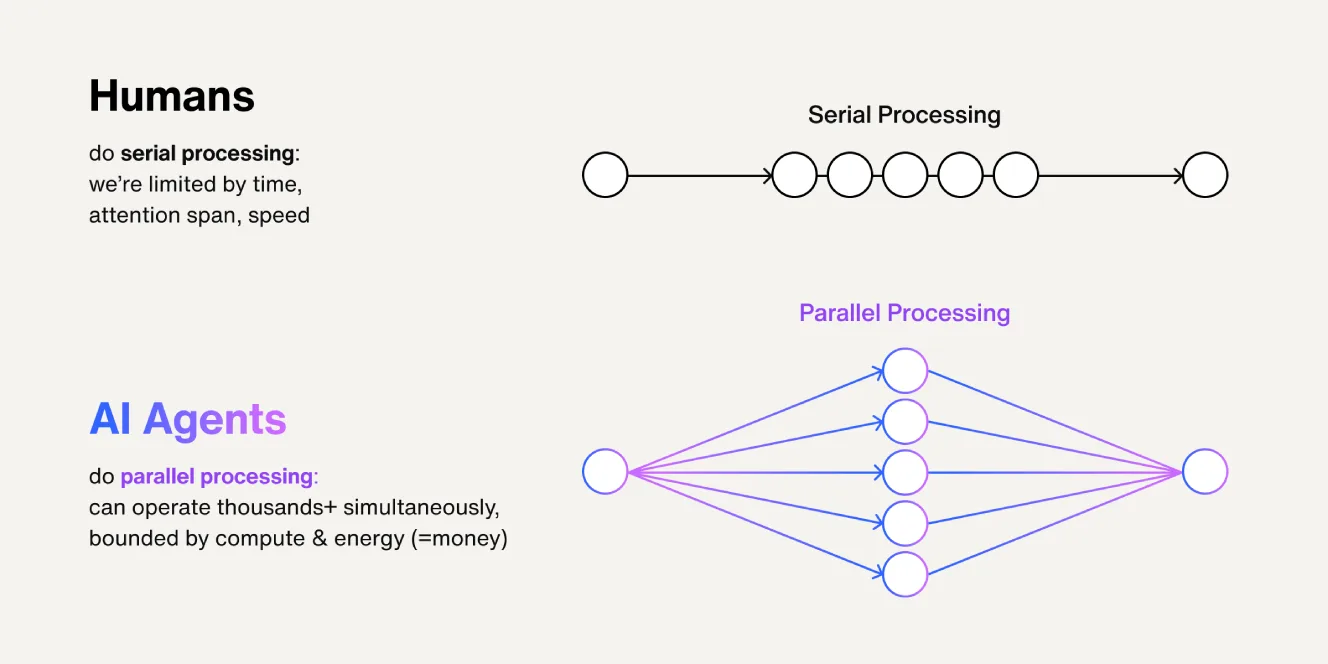
The era of simple prompts is over. We are witnessing the agent leap, where AI orchestrates complex, end-to-end workflows semi-autonomously. This marks a fundamental departure from the chatbots of previous years, shifting the focus from generating text to executing tasks.
AI agents in 2026 are autonomous systems that execute multi-step workflows, moving beyond simple Q&A to drive measurable business outcomes. They do not just answer questions; they connect to tools, retrieve data, and perform actions across different software environments. This capability transforms AI from a passive information source into an active participant in business operations.
The economic value of this shift lies in the reduction of human intervention. By handling repetitive, multi-step processes, agents free up human workers for higher-level decision-making. This transition is not merely technological but structural, redefining how work gets done in the modern enterprise.
Market trends shaping agent adoption
Enterprise adoption of AI agents is shifting from experimental pilots to core operational infrastructure. The primary driver is the transition from generative text models to agentic workflows that can execute multi-step tasks across enterprise systems. According to the 2026 State of AI Agents report by Databricks, organizations are prioritizing use cases that require autonomous decision-making and integration with existing databases, moving beyond simple content generation to actionable automation Databricks 2026 Report.
This shift is evident in the surge of specialized agentic AI companies entering the market. The Agentic List 2026 highlights 120 top companies focused on engineering and industry-specific solutions, indicating a maturation of the ecosystem where vertical-specific agents are replacing generic chatbots Agentic List 2026. Enterprises are increasingly demanding agents that understand complex regulatory and compliance constraints, driving demand for robust, secure, and auditable autonomous workflows.
The economic model for these agents is becoming clearer. Companies are not just buying software licenses; they are investing in the infrastructure required to support continuous agent learning and integration. This includes specialized data pipelines and security frameworks that ensure agents operate within defined boundaries. The market is consolidating around platforms that offer end-to-end agent lifecycle management, from design to deployment and monitoring.

The growth trajectory of AI agent deployment reflects this strategic pivot. As enterprises move from proof-of-concept to production, the focus is on measurable ROI through reduced operational costs and increased efficiency in complex workflows. This trend is expected to accelerate throughout 2026 as more organizations recognize the competitive advantage of autonomous systems.
Comparing AI Agent Frameworks
Choosing the right infrastructure depends on how much control you need over the agent's reasoning loop versus how quickly you want to deploy. In 2026, the market has split between low-code orchestration platforms and code-first frameworks that prioritize transparency and debugging. The table below compares the most prominent options based on deployment model, supported LLMs, and primary use case.
| Framework | Model Type | Supported LLMs | Best For |
|---|---|---|---|
| LangGraph | Code-First | OpenAI, Anthropic, Open Source | Complex, multi-step reasoning workflows |
| CrewAI | Code-First | OpenAI, Anthropic, Open Source | Role-based collaborative teams |
| Vapi | Low-Code | Proprietary (Voice-Optimized) | Real-time voice agents |
| AutoGen | Code-First | OpenAI, Azure OpenAI | Multi-agent research and coding |
LangGraph and CrewAI dominate the code-first space because they allow developers to explicitly define state transitions and error handling. This transparency is critical for enterprise environments where auditability is required. LangChain’s recent "State of Agent Engineering" report notes that organizations are shifting focus from experimental builds to reliable, scalable deployments, favoring frameworks that offer granular control over the agent's lifecycle.
For voice interactions, Vapi provides a specialized infrastructure that handles latency and telephony integration out of the box, removing the need to build custom WebSocket handlers. Meanwhile, Microsoft’s AutoGen remains the standard for multi-agent research tasks, particularly where code execution and iterative problem-solving are central. When evaluating these options, prioritize the framework that matches your team’s existing engineering stack rather than chasing the newest feature set.
Monetization strategies for autonomous workflows
The era of simple prompts is over. We are witnessing the agent leap, where AI orchestrates complex, end-to-end workflows semi-autonomously. This shift transforms AI from a passive assistance tool into an active economic asset, creating distinct pathways for revenue generation through monetization strategies for autonomous workflows.
B2B SaaS and API Access
The most direct route to monetization is embedding agents into existing business software or offering them as standalone API services. Companies are moving beyond basic chat interfaces to deploy agents that handle specific, high-value tasks such as supply chain optimization or automated customer support resolution. By charging per successful action or via tiered subscription models, providers can align their revenue directly with the utility delivered to the enterprise.
Internal Efficiency Gains
For many organizations, the primary monetization strategy for autonomous workflows is internal cost reduction. By deploying agents to manage routine operational tasks, companies can reallocate human talent to higher-value strategic work. This internal monetization is often measured by the reduction in operational overhead and the acceleration of cycle times, effectively generating profit through savings rather than direct sales.
Market Context
The economic viability of these strategies is closely tied to the broader tech market. As AI adoption scales, the infrastructure costs and market valuations reflect the growing demand for autonomous capabilities. Understanding these macro trends helps businesses position their agent offerings effectively.
Building reliable agents at scale
Moving from prototype to production requires a fundamental shift in engineering discipline. As organizations transition into 2026, the primary question is no longer whether to build agents, but how to deploy them reliably and efficiently. Reliability remains the central barrier to scaling autonomous workflows, demanding rigorous testing and monitoring frameworks before any agent touches live data or customer interactions.
Governance starts with visibility. You must track every decision an agent makes, not just the final output. This means implementing structured logging for tool calls, reasoning steps, and token usage. Without this granular telemetry, debugging a failed workflow becomes a guessing game. Official guidance from LangChain emphasizes that agent engineering is now a distinct discipline, requiring specialized tools to observe and control autonomous behavior.
Error handling cannot be an afterthought. Agents must be designed to fail gracefully, with clear fallback mechanisms when external APIs respond unexpectedly or when confidence scores drop below a threshold. This involves setting strict guardrails on what data the agent can access and what actions it can perform. By treating reliability as a core feature rather than a post-launch fix, teams can scale their agent deployments with confidence.
For teams managing high-stakes autonomous workflows, the cost of failure is significant. While specific market metrics fluctuate, the underlying infrastructure costs remain a critical factor in scaling. Monitoring the economic efficiency of these agents is as important as monitoring their accuracy.
No comments yet. Be the first to share your thoughts!