Fine-tuning LLMs in 2026: When It Pays Off
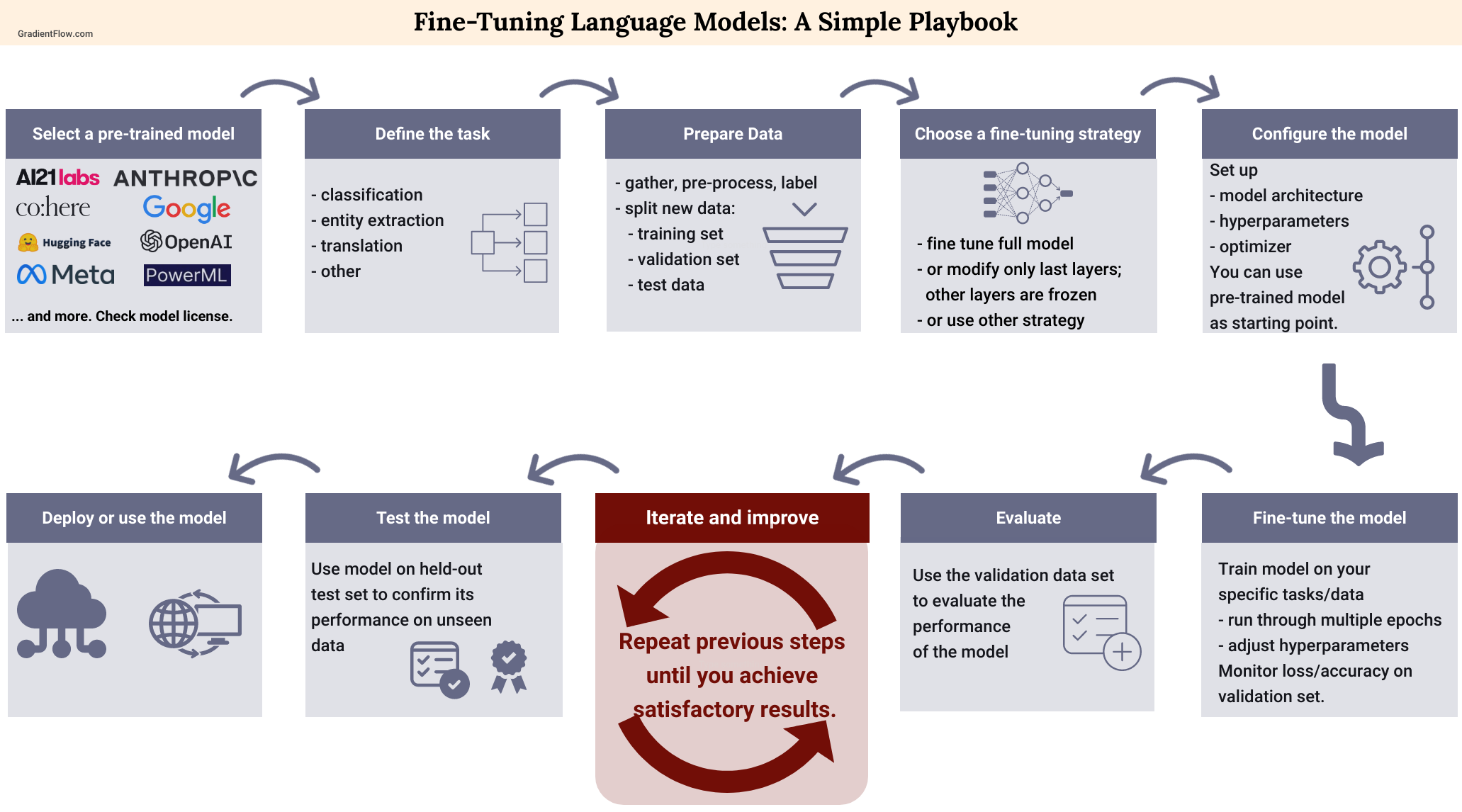
The playbook for fine-tuning LLMs in 2026 has shifted from a "train everything" mentality to a precise, sequential strategy. The current standard sequence is Prompt → RAG → Fine-tune → Distill. Most teams should limit their fine-tuning efforts to LoRA or QLoRA techniques, as full model retraining is rarely cost-effective for specific task adaptation.
Fine-tuning is no longer the default solution for every LLM problem. It is specifically designed to teach the model a new style, format, or domain-specific reasoning that Retrieval-Augmented Generation (RAG) cannot handle. If you are trying to inject factual knowledge, RAG is usually superior because it updates the context window without changing the model weights. However, if you need the model to consistently follow a complex output schema, adopt a specific brand voice, or reason through proprietary logic, fine-tuning is the only reliable path.
The decision to fine-tune hinges on the tradeoff between capability and maintenance. Fine-tuned models are smaller and faster, which reduces inference latency and cost. They also offer more predictable behavior in production environments. The downside is the engineering overhead: you need high-quality, curated datasets and a robust evaluation pipeline to ensure the model doesn't hallucinate or lose general capabilities. Without this infrastructure, the ROI of fine-tuning remains negative.
For most organizations, the sweet spot is using LoRA adapters to specialize base models for distinct sub-tasks. This approach allows you to maintain a single base model while swapping in lightweight adapters for different use cases, such as customer support summarization or legal contract review. This modular strategy maximizes flexibility while keeping the computational footprint low.
Fine-tuning LLMs in 2026: Tradeoffs and Decision Factors
Choosing the right optimization path in 2026 requires balancing data quality, compute costs, and latency. The default sequence for most teams has shifted to Prompt Engineering → Retrieval-Augmented Generation (RAG) → Fine-tuning → Distillation. Full retraining is rarely justified unless RAG fails to capture specific reasoning patterns or domain nuances. The decision hinges on three concrete factors: data scale, inference latency, and long-term maintenance.
Data Volume and Quality
Fine-tuning is data-intensive. While RAG can leverage thousands of documents, fine-tuning typically requires hundreds to thousands of high-quality, labeled examples to show measurable improvement. Low-quality or noisy data leads to model degradation, a phenomenon known as "catastrophic forgetting," where the model loses general capabilities while learning specific tasks. The cost of curating this data often exceeds the compute cost of training.
Compute and Infrastructure
Full fine-tuning demands significant GPU resources, making it expensive for most organizations. Low-Rank Adaptation (LoRA) and Quantized LoRA (QLoRA) have democratized access by reducing the memory footprint by up to 75%. These methods allow fine-tuning on consumer-grade GPUs or smaller cloud instances. However, they introduce a slight latency overhead during inference compared to a fully optimized base model. Teams must weigh the cost savings of QLoRA against the performance hit in high-throughput production environments.
Latency and Operational Overhead
Fine-tuned models are smaller and faster than large base models used with RAG, reducing inference latency. However, they require a dedicated serving infrastructure and continuous monitoring to prevent drift. RAG, by contrast, offers lower latency variability but higher computational overhead per query due to vector search. For applications requiring sub-second responses, a fine-tuned distilled model often outperforms a RAG-heavy pipeline.
| Method | Data Scale | Compute Cost | Inference Latency | Best Use Case |
|---|---|---|---|---|
| RAG | High Volume | Low | Medium | Dynamic knowledge retrieval |
| LoRA/QLoRA | Medium | Medium | Low | Specialized domain tasks |
| Full Fine-Tune | High | High | Low | Complex reasoning patterns |
| Distillation | Low | Low | Very Low | Edge deployment |
How to choose the right fine-tuning path
Most teams waste budget on fine-tuning when RAG or prompt engineering would solve the problem. The 2026 decision framework follows a strict sequence: prompt, then RAG, then fine-tune, then distill. Only move to fine-tuning when retrieval fails to provide the specific context, tone, or structural constraints your model needs.
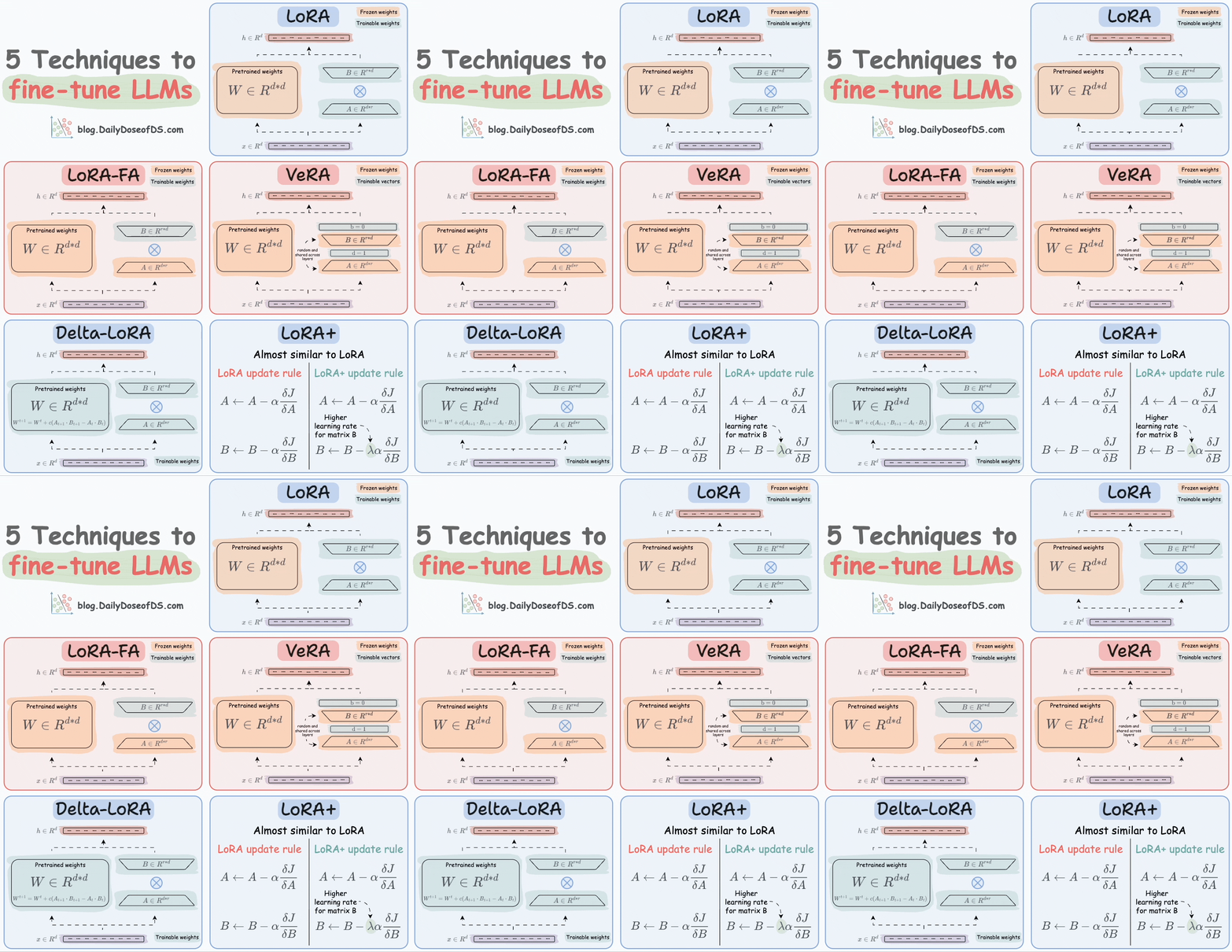
If you decide to fine-tune, stick to parameter-efficient methods like LoRA or QLoRA. Full model retraining is rarely justified by the ROI in 2026. Your choice of platform should depend on your data volume and infrastructure constraints, not just feature lists.
Before touching model weights, test structured prompts with clear system instructions. Many "hallucination" issues are actually prompt ambiguity. If a well-structured prompt handles the task, you have zero fine-tuning costs.
If your model lacks current data or domain-specific facts, add Retrieval-Augmented Generation. RAG allows you to update knowledge without retraining. It is the standard solution for factual accuracy and proprietary data access.
Use fine-tuning only when RAG cannot enforce specific output formats, tone, or complex reasoning patterns. LoRA or QLoRA allows you to adapt a base model for these stylistic nuances at a fraction of the cost of full training.
After fine-tuning, distill the large model into a smaller, faster model for production. This step preserves the learned behaviors while significantly lowering latency and compute costs for high-volume inference.
| Method | Best Use Case | Relative Cost |
|---|---|---|
| Prompt Engineering | Simple tasks, clear logic | Lowest |
| RAG | Dynamic knowledge, facts | Low |
| LoRA/QLoRA | Style, format, niche reasoning | Medium |
| Full Fine-Tuning | Rarely needed in 2026 | High |
The decision ultimately rests on what your model cannot do with the tools above. If retrieval fails to provide the right context, fine-tuning is the next logical step. If the model still struggles with structure after fine-tuning, consider distilling to a specialized smaller model for production efficiency.
Spotting Misleading Claims in Fine-Tuning
Many vendors promise that fine-tuning alone solves hallucination problems. This is rarely true. Fine-tuning adjusts weights to fit a specific distribution; it does not inject new facts or ground the model in external reality. If your primary issue is outdated or missing information, fine-tuning will likely waste compute and budget. The effective sequence in 2026 is Prompt -> RAG -> Fine-tune. Only after retrieval fails to provide context should you consider adjusting the model weights.
Another common trap is ignoring the cost of distillation. While LoRA and QLoRA reduce training expenses, deploying multiple adapters for different tasks increases inference latency and operational complexity. Without a clear plan to distill these adapters into a single base model, your ROI will erode quickly. Compare platform capabilities carefully; some tools automate this distillation, while others leave it to you.
Beware of platforms that bundle fine-tuning with proprietary, locked-in formats. If you cannot export your weights or adapters to open standards like Hugging Face, you risk vendor lock-in. Always verify that your chosen tool supports standard LoRA exports and integrates with your existing MLOps pipeline before committing to a long-term contract.
Fine-tuning llms 2026: what to check next
Fine-tuning is no longer the only path to better performance. In 2026, the standard sequence is Prompt -> RAG -> Fine-tune -> Distill. You should only fine-tune when RAG fails to provide enough context or when you need to embed proprietary logic directly into the model weights.
LoRA and QLoRA are the only fine-tuning approaches most teams should use today. They allow you to update a small fraction of parameters, reducing memory requirements by up to 75% while maintaining accuracy. Full model fine-tuning is rarely justified unless you are training from scratch on a specialized dataset.
The cost of fine-tuning has dropped significantly. With open-source frameworks like Axolotl and platforms like Predibase, you can run experiments on consumer-grade GPUs or cloud instances for under $50 per hour. The real cost is now in data preparation and evaluation, not compute.
No comments yet. Be the first to share your thoughts!